Co-invention and knowledge transfer in science-industry collaboration: Evidence on Recombinant Novelty
- Theme
- Economics of Innovation · Science of Science
- Status
- Working Paper (2025)
- Output
- No public link yet.
Read abstract
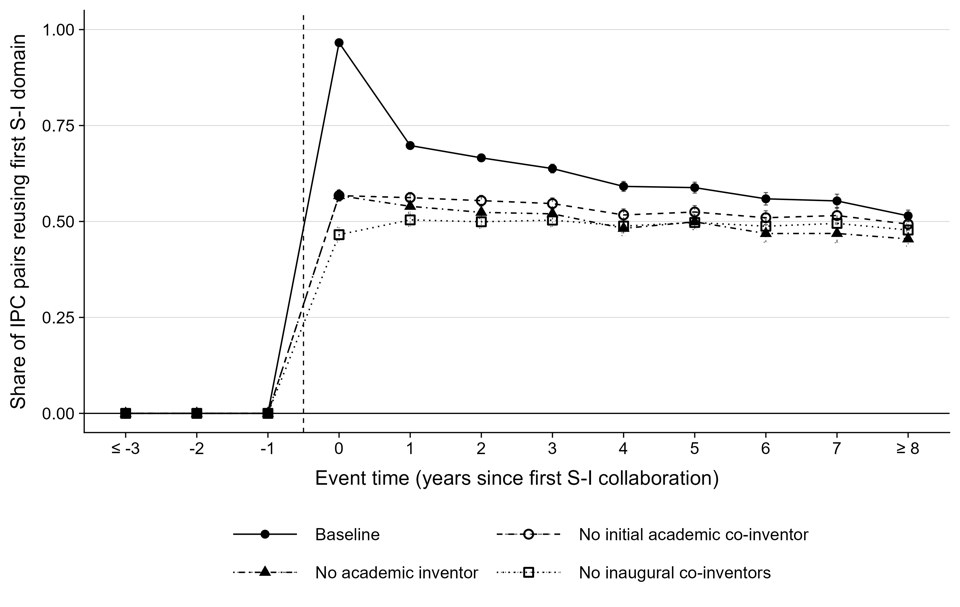
How does collaboration with science change the direction of inventive activity? We study non-academic inventors' first co-invention with an academic partner using French patent data from 1976--2013 matched to scientific-author information. Measuring recombinant novelty as IPC4 combinations new to an inventor's prior technological history, we estimate dynamic effects with staggered difference-in-differences designs. A first science--industry collaboration generates a sharp but short-lived increase in exploratory recombination: inventors produce more new technological combinations in the collaboration year, while the share of novel combinations subsequently declines. We show that this pattern reflects a transition from domain opening to domain integration. The initial shock is driven by combinations involving new technological components, whereas later recombination increasingly combines newly accessed IPC classes with the inventor's prior technological portfolio. The domain opened by the first academic collaboration also continues to be reused in later patents, including outside the initial academic partnership and original co-invention team. These findings are consistent with science--industry co-invention operating as a learning-by-doing event that reshapes industrial inventors' search repertoires.